Dear friends,
To educate, one must first entertain.
That is one of the core beliefs of Maxfield on Banks.
The purpose of Maxfield on Banks is to bring attention to megatrends in American banking that few follow and even fewer are sufficiently versed in to opine on in an informed manner. We use storytelling as the vehicle to do so.
At the peak in 1921, there were more than 31,000 banks in the United States. Today, there are roughly 4,000. Half the decline occurred in the 1920s and 1930s — decades plagued respectively by agricultural and economic depressions. The other half has taken place in our lifetimes, ignited by a U.S. Supreme Court decision in 1985 upholding the constitutionality of regional banking compacts and thereby opening the door to interstate banking.
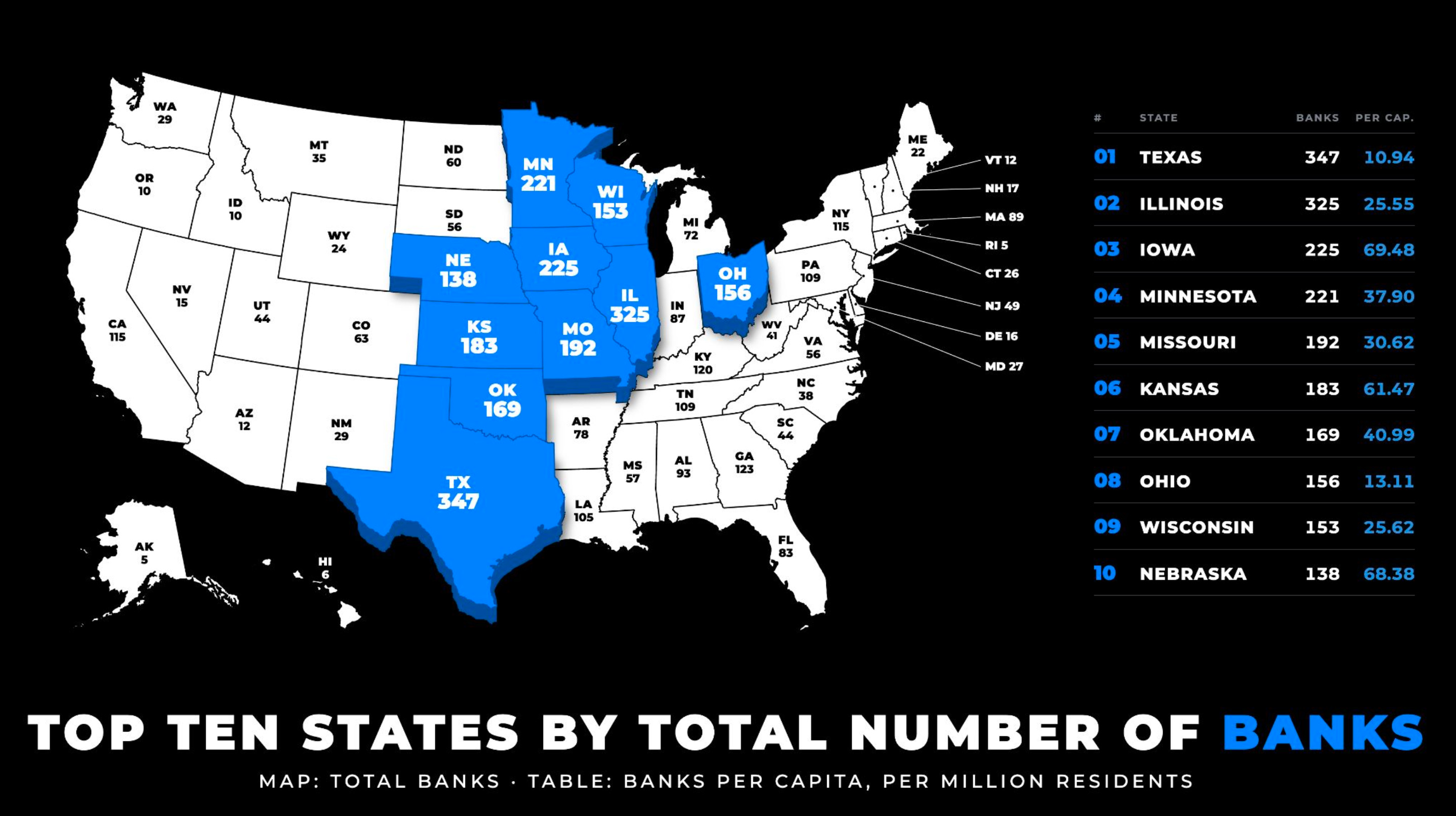
The consolidation that began in the mid-1980s has unfolded unevenly. Oregon and Arizona have fewer than a dozen banks headquartered in their states, while Iowa, Illinois and Minnesota are still home to more than 200 banks each. Indeed, if you look across the country today, you’ll find that more than half of the banks are based in just 10 states. And all those states sit in the middle of the country, where the topsoil is deepest and the agricultural economies most vibrant.
This isn’t a coincidence. Agricultural lending is more rigorous than lending to consumers or on commercial real estate, processes that a plethora of AI vendors are seeking to solve for banks. Ag lending requires hyper-local knowledge about the land, the area and the operators. Thus why consolidation has come to these states last.
The future of the American banking industry is one of further consolidation. Obviously.
Federal policymakers have made it all but impossible to start a traditional bank given the capital requirements. Sure, there’s a backlog of charters waiting on approval by the OCC. But many of those charters are for banks with unconventional models — banks like Erebor, which is being built to serve high-growth sectors like artificial intelligence, defense technology and cryptocurrency. A traditional de novo charter in a small town, by contrast, has almost no chance of raising the presumed $25 million needed to get off the ground.
To most bank analysts, this is an issue they experience in Microsoft Excel. But Maxfield on Banks has dug deeper. We have traversed the country, from Alaska to Florida and very many places in between, visiting bankers, their customers and local residents and politicians. And what we have found is that community banks in particular are critical in ways that aren’t captured by Wall Street models.
I’ve said this before and it is true: The difference between a town that has a community bank based in it and one that no longer does is the difference between the parks in that town being maintained and the grass at the elementary school being mowed. At the Goshen County Fair last year in Wyoming, where I grew up, the most prominent sponsors were small, local banks. The same is true when it comes to support for children’s programs like soccer and 4-H.
Banking isn’t just banking. It is everything. This is why it’s worth slowing down and asking ourselves what happens to all these towns and midsize cities when our remaining community banks — the capillaries of American commerce — are absorbed into megabanks that reallocate rural deposits into larger metropolitan areas.
Maxfield on Banks believes we need more, not fewer, community banks. And we also believe in the power of stories to bring light to this important issue. Best story wins. If we’re going to consolidate our banks away, Maxfield on Banks wants to make sure we do so with our eyes wide open.
The American banking industry is uniquely American. We are a country of misfit risk takers whose ancestors boarded boats hundreds of years ago, crossed the Atlantic, and traversed the continent on wagons, then trains, to establish new communities across its interior. And just about everywhere they stopped, someone opened a bank that fueled their community’s rise.
Nowhere else in the world is like us. And we should be proud of these differences and explore ways to maintain them.
It’s for this reason that Maxfield on Banks does the ridiculous things it does. It’s why I taught myself how to make documentaries. It’s why I drone myself while standing on top of banks. It’s why I dress and act the way I do.
To educate, one must first entertain.
Maxfield on Banks couldn’t do this without the help and support of people and companies who share in its mission to support the American banking industry. That’s why we carefully curated the sponsors for our Maxfield on Banks Masterclass that we hosted earlier this month in Dallas.
The day before the Masterclass opened, KlariVis founder and CEO Kim Snyder and I co-hosted an Executive AI Roundtable at the Park City Club in Dallas.
Craig Haymaker, managing director of hedging solutions at Eris Futures, joined us on stage on the first day to talk about how community banks can manage interest rate risk with hedges and swaps.
Kirk Coleman, chief business officer for digital banking provider, Q2, has helped scores of banks navigate the digital banking revolution and discussed this on stage during lunch on the first day.
Later that night, Fin Capital hosted our group dinner on the rooftop terrace of The Joule Hotel. No lessons, no slides. Just dinner and conversation.
And to start the next morning, Colton Pond, Global CMO at Socure (a platform for digital identity verification) joined us to talk about the frameworks that make a brand extraordinary and how smaller banks can protect themselves from fraud.
We, at Maxfield on Banks, thank our sponsors and look forward to working with all of you again in the future.
What’s next
We had a swarm of videographers filming the whole thing. This week, I’m headed back to Dallas to record the core of the Maxfield on Banks curriculum. We’ll be putting it all together into a Digital Masterclass. It’s designed to be a comprehensive, contemporary guide to banking. Whether you’re a seasoned bank executive or a service provider looking to strengthen your command of the industry, there’’ll be something in it for you.
If you want to be among the first to know when it’s ready, hit reply.
Thank you to everyone who came, spoke and sponsored. And thank you, as always, for reading.
Your friend in banking and life,
John J. Maxfield